No Brown M&M’s

By Franklin R. Dumond

When Van Halen’s rock concerts expanded to new markets, Article 126 was added to their production contract. This obscure instruction was buried among all the details of weight limits, rigging points and door widths required to bring in, set up and operate the several truckloads of equipment and staging used in the concert.

m and msArticle 126 seemed odd, even unnecessary. It simply required that backstage should be equipped with a bowl of M&M candies. The stipulation continued that all brown M&M’s be removed. Even a single brown M&M could result in forfeiture of the show with full compensation paid to the band by the promoters.

At least one concert was cancelled when brown M&M’s were discovered. The appearance of a brown piece of candy indicated to the band that other contract requirements had probably not been followed. At the cancelled concert, local promoters had not only allowed brown candy, but had also failed to read the weight requirements for staging and equipment. If the concert had not been cancelled the arena’s stage would have collapsed under the weight of the equipment needed for the production. (See Crazy from the Heat by David Lee Roth)

We don’t usually serve M&M’s while doing ministry, but there are at least five little things that when left unattended can be red flags of danger. These red flags may signal imminent decline or even impending death of once thriving churches.
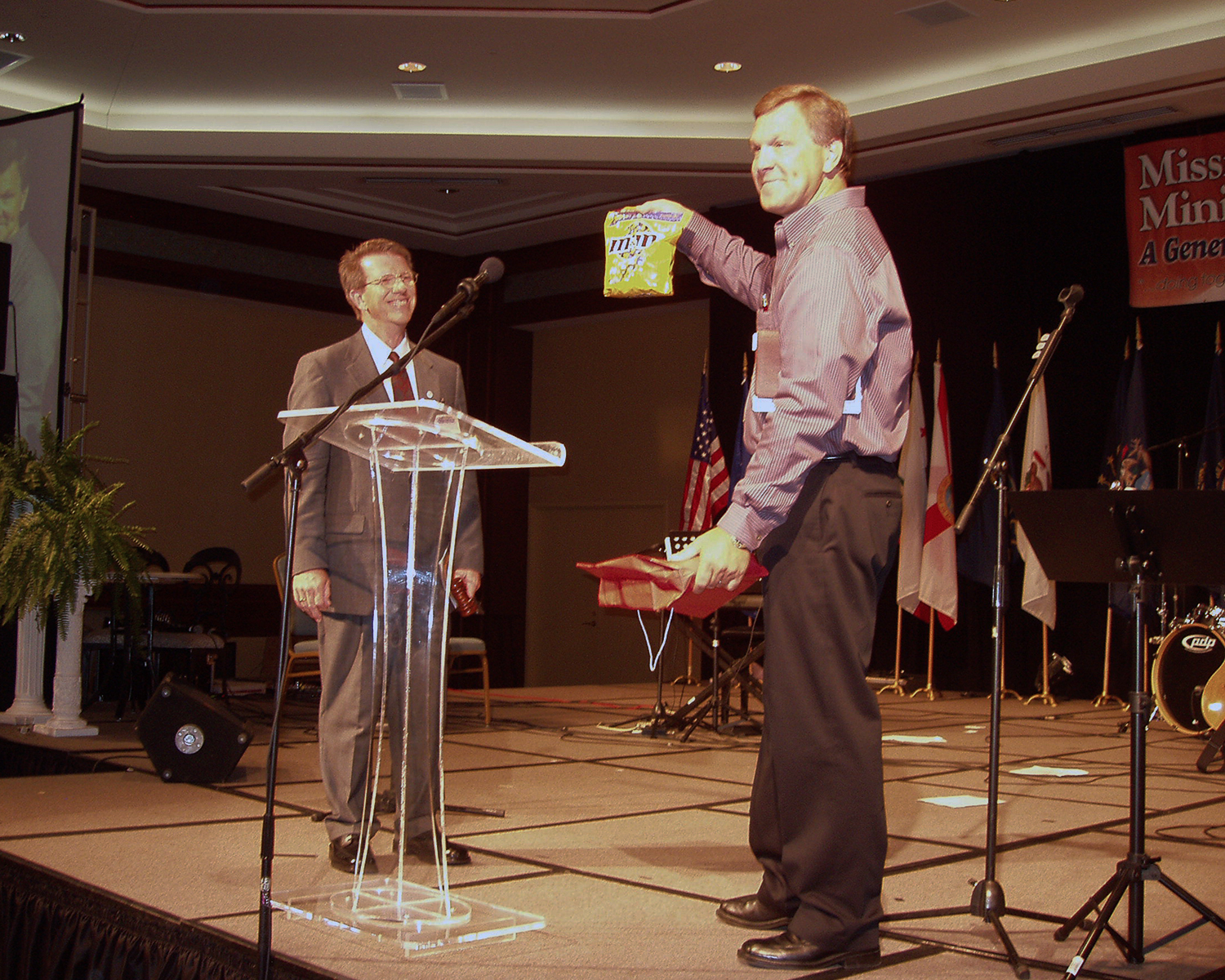
At the 2007 Summit, we actually did serve M&M's!

At the 2007 Summit, we actually DID serve M&M’s!

1. Dust and Clutter It happens so gradually that regular attenders become accustomed to it while guests cringe. It is especially distasteful when it happens in restrooms, foyer areas and kitchens. One solution to this might be a good spring cleaning day or fall workday with specific lists of areas to be cleaned and items to be stored properly.

2. Spelling Errors This used to be confined to the weekly bulletin that was hurriedly composed in preparation for Sunday. Word processors have eliminated many of those glaring errors while also introducing the new peril of a correctly spelled word that is the wrong one. (i.e. ‘the’ when ‘they’ was the intended word) Projection systems also introduce a new arena for error since song lyrics and announcements tend to be saved for future use. Unfortunately first time errors will not be corrected by merely saving the work for second time use. Two solutions here include having every printed piece read by at least two people and having someone make a list of projected errors so they can be corrected.

3. Inadequate Signage Even small buildings benefit from a few well-placed directional signs. Restrooms and nurseries should be easily located. Children’s areas, especially if the church invests in extended children’s worship/ministries, should be identified. A possible way to identify signage needs might be to ask a friend to visit the building for the first time and then report how easy or difficult it was to find needed areas based on the available signage.

4. Dated Color Schemes While some colors and décor remain classic others change with every generation.   Classic architecture and genuine antique furnishings never go out of style if properly maintained, while the pastels of the 70s and the heavy earthen tones of the 80s have been replaced by new preferences. Glaring fluorescent tubes may be easily replaced with fixtures that use even less energy while producing a more natural light. A solution to this issue might be to look back to when the church was last repainted or redecorated, and to determine a schedule of revisiting décor at least every 5-7 years.

5. Light Bulbs and Trash Cans While possibly an extension of dust and clutter this area warrants a separate listing. If light bulbs are burned out and trash cans are full urgent attention is required. In a recent visit to a church I almost asked where the janitor’s closet was located because I counted so many light fixtures that needed new bulbs! The only solution to this red flag is for someone to take the time to change the bulbs and empty the trash cans!

While this list may seem a little silly, or even inconsequential, it has been my experience that a church that does not give attention to these little things will not give attention to the big things of missions and evangelism and discipleship.

What little things have you noticed that, when left unattended, become major things? Click “Leave a Comment” at the top of this article to share your experiences with us.

The Value of Pastoral Relationships

By Clint Cook

Over the last few weeks, I have reflected on the value of attending conferences.  As I’ve stated before, this idea is not a new one in the church.  We find examples in the Word of God where Jesus himself would withdraw from the pressures of ministry and take those he ministered with away for intense discipleship training.

Last week, General Baptist ministers gathered at the 2014 Minister’s Conference on Kentucky Lake.  Executive Director Clint Cook shares on why pastoral relationships are importantI was allowed the opportunity to speak on the last evening.  As I prepared for this final session, where both new and experienced ministers were in attendance, I was led to speak on a puzzling passage of scripture in the Old Testament, found in 1 Kings 13.  In this passage, God commissioned a young prophet from the southern nation of Israel to go to the northern tribes and pronounce a sobering prophecy to King Jereboam.  God told him he was to speak the message and then go directly home, without eating or drinking anything.  The young prophet obeyed God’s directions and did exactly as he was instructed-until he was on his way home.  Meanwhile, an older prophet heard of the young prophet’s mission and met up with him as he journeyed home.  When these strangers met, for some reason unknown to us through the scriptures, the older prophet decided to lie to the young man.  He told him that an angel had instructed him to bring the young prophet to his home and share a meal.  The young prophet trusted the old prophet and agreed.  While the men were eating, God spoke to the older prophet and told him to declare that the young prophet would lose his life because he had failed to fully obey God.  As the young prophet proceeded home, a lion attacked him and he was killed.  The older prophet mourned the death of the young man and was so affected that he requested that upon his death, his sons bury him with this younger prophet.

I agree.  This IS a very bizarre passage.  Don’t you wonder why the young man would so quickly turn aside from doing exactly what God had told him?  And why the old prophet would lie and deceive the young man?

I believe this story is here for us to learn two very important lessons.  First, we must ignore distractions and follow through with doing exactly what the Lords tells us.  Second, we must not blindly trust the advice of others, even ministers, just because they are older.

Ministers building relationships at the 2014 MinConAfter such a sobering story, how can young prophets/ministers keep from being deceived by older ministers or saints in the faith?  The simple answer is that they must get to know them.  In the above story, neither of these men knew one another.  If they had known one another, known each other’s hearts, known each other’s motivations and goals, there may have been a different ending.

This is yet another reason why conferences, like the General Baptist Minister’s Conference, are so valuable.  Older, more mature Christians must get to know younger ones.  Young preachers need to hear mature ministers share their hearts, struggles, and goals, all of which remove the stranger barrier and help prevent deception from happening.  When you listen, interact, and share with others, you are more equipped to discern whether another believer is truly looking out for your best interest and offering sound advice.

You might say that if the young prophet had remained focused and done only what he was directed to do, this may not have happened.  Or, if they old prophet had not lied this may not have happened.  Both of those are true, but I also believe that if both of these men had known each other, their story would have turned out differently.  I am so thankful for the fellow ministers and believers who want to sharpen their discernment by building relationships with one another.

General Baptist Ministries offers several conferences throughout the year.  The upcoming Mission and Ministry Summit will take place July 21-23 in Springfield, Illinois and you do NOT want to miss it!  To register, head over to generalbaptist.com or call 573-785-7746.


Summer Time

By Carl Nichols

Cookouts, sunshine, swimming pools, and vacations are all a part of summer.  No doubt people from your church will travel, and attendance will likely look like a roller coaster ride from June through August.  With that in mind, our staff at Relevant work very hard to set and manage expectations while seeing fruitful results during the summer.  Here are 5 things we have learned:

  1. Don’t assume that you can’t grow during the summer.  Although most churches do see numerical dips, don’t give up during the summer.  Even if you don’t grow, understand that this can still be used as a season of equipping and preparing for a healthy fall season.
  2. Look for relational opportunities for your people to connect.  Memorial Day, July 4th, and Back to School Blowouts are always relational and build excitement.
  3. Don’t do something just to do it.  If it doesn’t fit your mission, vision, and values, say an emphatic NO.  During the summer, all staff should take some down time.Always clarify the win for any event or activity you play so you have a clear scorecard of your success.  For more on mission, vision, and values, make sure and attend the first session of our “Healthy Church” track (The Foundation) at Summit.
  4. Make sure you, your pastor, and your staff all take some down time.  Everyone expects you to take a break in the summer.  They do!  You should, too!  I take 3-4 weekends off from speaking during the months of June and July.  This allows our people to hear from other great communicators, many of whom are a part of our own movement or staff.  Additionally, I make sure each of our staff has a couple of weekends to themselves as well.
  5. Do something fun for your kid’s ministry that makes them want to attend as much as they can, and even be excited enough to bring a friend.  This year at Relevant, we are doing “Red Hot Summer” that is focused on something red or hot every week of June and July.  Popsicles, sunglasses, and beach balls are just a few examples.

summer-49019_1280At Relevant, we kick off summer on Memorial Day weekend with a family fun day with water games, activities, food from the grill, and a very intense young versus old softball game.  Additionally, we kick off “fit groups” for relational building while people work to get that beach body they have always wanted.  Our win here is relationships that cannot be built on Sunday morning and that sometimes fall by the wayside because many of our small groups don’t meet during the months of June and July.

What’s your biggest summer struggle?  Click on ‘Leave a Comment’ at the top and join the discussion!