Nickels, Noses, Numbers

By Dr. Franklin Dumond

The role of numbers and counting in the life of a church leader, though often criticized, remains important. The effective leader has a penchant for numbers, since most of those numbers represent people or indicate a measure of their discipleship.

Are numbers necessary?

A quick look at the Bible illustrates the historical importance of numbers. There is even an Old Testament book called Numbers! The New Testament records the numbers of people who had lunch with Jesus—4,000 on one occasion; 5,000 on another—and even how they sat in groups of 50 (Luke 10:14).

Necessary Numbers

A few numbers rank with such importance that every church leader should be abreast of them. Ranked by importance these would include:

  1. Average weekly worship attendancegraph
  2. Average weekly Small Group/Sunday School attendance
  3. Number of First Time Guests
  4. Conversions: Last year and year-to-date
  5. Baptisms: Last year and year-to-date
  6. Members Received: Last year and year-to-date
  7. Average Weekly Income: Last year and year-to-date

Most of these numbers should be maintained in a multi-year graph so trend lines can be easily identified.

Behind the Scenes Numbers

Some of the most important numbers only rarely make a ‘public’ appearance. That is, they are generally not communicated openly, despite their importance. The leader of a growing congregation will undoubtedly be aware of:

  1. The size of the crowd

“If everyone had been here…” is a statement often made to console us on low attendance days or to celebrate a full house that would have been beyond capacity if everyone had been present.

The crowd is composed of those folks who attend at least once in a while. One convenient measure of the crowd is to identify those folks who attend at least once every 6-8 weeks.

Why is it so important to know the size of and the identity of the crowd? The size of the crowd indicates the potential the church has to grow and impact people. The identity of those who make up the crowd indicates who it is that we are most likely to win to faith in Christ and faithfulness to His church.

  1. Total weekly participation

In the Family Based Church, everyone attends everything. These churches function like an extended family, and are generally smaller in size. It is not uncommon for activities to be cancelled if several cannot attend.

A Program Based Church will have a more developed and diverse program where no one attends everything but everyone attends something. For example, it is not uncommon for a Program Based Church to offer small groups for adults, youth groups for teens, and children’s ministries at times other than Sunday morning. Often folks who cannot attend on Sunday morning will nevertheless participate in one or more of the weekday or weeknight ministries of the church.

Total weekly participation, then, is a measure of who attended at least one ministry activity in a given week. It is determined by a cross reference of attendance reports so that everyone who attends at least once in the week is counted.

  1. Percentage of the congregation present for five years or less

“I’m on my third congregation!” reported the pastor of a middle sized church. Having been pastor there for nearly 20 years he had discovered first hand that church folks are mobile. They move away. They drop out. Others drop in. Every year there are funerals!

Other measures of tenure could be used. A very important one is the percentage of folks who have become part of the congregation since the current pastor arrived.

Each of these measures the likelihood of leading change and maintaining relevance. Change is most likely when enough newer folks with newer ideas come into leadership roles. The pastor is most likely to lead change when a large percentage of the congregation has come into the church since he began his ministry.

Numbers will not track themselves. Use of some church management software or the development of a spreadsheet will make the task easier. In the church of 200 or fewer a good notebook and clipboard will cover most of the bases. Volunteer office helpers can do much of the record keeping. Whatever system is used, however, must ring true to the old adage “We count people because people count!”

Age Appropriate Evangelism Part 2

By Franklin Dumond

This is the second and final installment of an article on approaching Children’s Ministry by Dr. Franklin Dumond. Read the first half HERE.

While even very young children can be placed in an environment that accelerates their learning, we now recognize that there can be significant drawbacks to Forced Teaching. A child can repeat from rote memory what has been presented without actually learning the concepts they were taught, making it appear that real learning has taken place.

Given this pattern of human development, it appears that the Lord has created us with the capability to respond most readily to the gospel somewhere about 8-10 years of age.

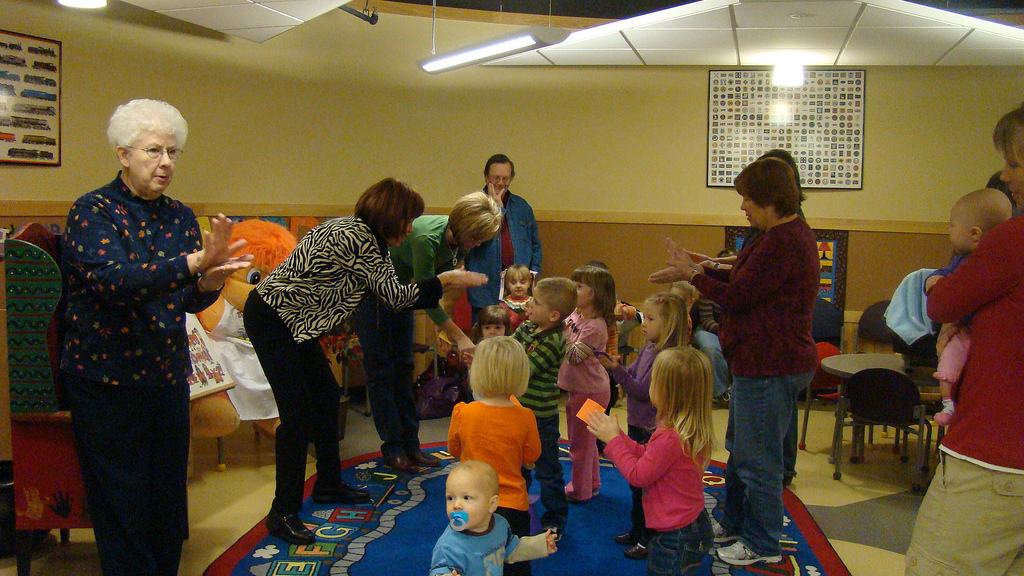
preschoolers in classroomFourth, successful evangelism of children will result from an alignment of process. When the same concepts are expressed in the pre-evangelism of young children and in the evangelism of children, teens, and adults, evangelistic work will be more successful. When similar visuals and words are used throughout the process, evangelistic activity will be more productive.

A visual demonstration of our lostness and the need for a Savior can be presented by a simple game that portrays the Bridge Illustration frequently used while sharing the gospel.

Use a few children from the group to play the roles. If the group is small or if this is a pre-evangelism activity for younger children, use everyone. Indicate a starting point for the children and stand near an ending point, 5-10 feet away. Help them imagine that they are on one side and God is on the other side.

Ask them to jump across the distance so they can reach God. Since they only get one jump some will make more progress than others, but none of them will make it all the way. Some of the boys will believe that if they can have a running start or if they can try one or two more times, they can surely make it. Let them try.

Help them imagine a cross that bridges the gap. For younger children, having an actual cross on the floor will be helpful. Ask them if they can walk across the bridge to God.

For older children, explain how we respond to the gospel and invite them to do so. Using a simple gospel handout can help those who read to see the related Bible verses and have something they can take home and reflect on. Build the entire presentation around the key verse of I Timothy 2:5:

For there is one God and one mediator between God and men, the man Christ Jesus,

Explain that God is on one side and all people are on the other side, and Christ Jesus, himself man, is between them to bring them together by giving his life for all mankind.

Basic Principles of Evangelism for Children:

1. FREQUENCY—It can be very helpful to view the church as having a three semester year in its programming. This means that repeated emphases can be scheduled for late fall, early spring, and summer since attendance patterns and programming often follows these patterns.

2. CONTEXT—Evangelism for children should occur within the context of existing children’s ministries so that it is a natural expression of what the church is and does. Specialized settings should be avoided so that the decisions being made are genuine and not the result of peer or environmental pressure.

3. AGE STRUCTURED—Evangelism for children should be targeted to those children who can appropriately respond. While pre-evangelism can be done in groups with a variety of ages, the opportunity to respond should not be extended to younger children. A separate meeting area may be needed so each group can be treated in an age appropriate manner.

Evangelism Night:

1. Advance prep/counselor certification ensures that those who assist are all on the same page.

2. Seating arrangements: for both control and response it is better if children are not crowded together. This allows them to focus on the material and to respond for themselves rather than to respond to the peer pressure imposed because others around them are responding.

3. Age structure means there will be different lesson plans for younger children who are in the pre-evangelism mode.

4. Preliminary worship is always helpful to set the stage.

5. The gospel presentation should be simple, clear, concise.

6. Plan for a response time, and discuss with all adult volunteers how they should respond to the children.

7. Use one-on-one follow up counseling as much as possible with open ended questions to confirm what the children have heard and how they are responding. This breaks the evening into a two part process of a presentation and a follow-up.


Navigating God’s Will

By Carl Nichols

Several weeks ago my wife received a phone call from a friend regarding a potential opportunity for our family. I will spare the details, but essentially it involves a widespread platform in which our family values will be on Carl Nichols discusses the new church planting initiative at the 2014 Summit.display. Because of the somewhat controversial nature of the topic, Julie and I had to really evaluate if it was right for our family or not. When opportunities present themselves in our lives, we always try to follow a simple process that helps us determine if this is right for us.  We ask a series of questions that help us navigate the process. I though I would take some time to share this approach with you.

Does this in any way conflict with our biblical worldview?

Ultimately, like many who will read this blog, our worldview centers around the scriptures. Many things are black and white in the scriptures and many are gray areas that are left to us to make the wisest decision. If the evidence points to this opportunity conflicting with the teachings of the scriptures, then clearly we let it lie. If in fact it is unclear, we ask ourselves this question, “In light of our past experiences and future hopes and dreams, is this the wisest thing for us to do?”

Does this put our family or our relationship at risk? If so, are the risks calculated and worth it?

We do not ask this question so we can run from risk, but rather help us understand the risk involved. If in fact our family values have to be compromised, then again we will not engage. More often than not there is some risk involved in every great opportunity. We must know what the risks are, and plan and protect our family accordingly.

Will others benefit from us doing this?

This is such a counter cultural question. When most would ask, “Will I benefit?” we try to heed the words of Paul in Philippians 2:3 by asking how this can be used to benefit others. This is not my nature-I want to be the point. I want to benefit. However, it cannot be about me or us or it will likely fail. There are, of course, business opportunities that we have been a part of that did not help anyone but ourselves. However, there are also things that we have done with no benefit to us, but exponential benefits for others. It’s a delicate balance.

Is this the right time?

Regarding this particular opportunity, we decided to pursue it. However, the same day of the final meeting, I sustained a serious injury that could effect the situation. I don’t know how it will turn out, but I am open to the fact that now may or may not be the right time. If the injury causes the other party to pull back, then that brings some clarity. If, however, we both chose to move forward, then this injury may be even more a part of the platform.

What are the consequences of not doing this?

Whose lives will be effected negatively? What gospel opportunity will be missed? What will my kids miss out on? These are just a few questions we carefully consider.

Will we regret letting the opportunity pass?

I will just sum this up with this statement: I would rather get to the end of my life and regret trying some things and failing, than not trying those things and regret the missed opportunity. I believe at the end of our lives we will regret the “sins of omission” much more that the “sins of commission.” That’s just a personal belief, but I challenge you to ponder it.