By the Restructure Task Force
MOVING TOWARD RESTRUCTURE OF GENERAL BAPTIST MINISTRIES
In April 2019, the Executive Council of the Council of Associations (the functional board of directors for the organization), created a task force to study possible restructure of all General Baptist ministries.
The group was asked to evaluate the current structure of the Council of Associations, to develop a system and strategy to move us forward and to make recommendations to the Executive Council to implement a new system.
EVALUATION AND RESULTING VALUES
As part of the evaluation process, the Restructure Task Force (RTF) held several meetings between August 2019 and January 2020. In that time, initial data was collected and reviewed. A series of listening sessions were also held in February and March 2020 to gain additional feedback from across the movement. The data was joined with previously gathered information and the outcomes of the conversations of the RTF to develop a list of perceived issues and values to be addressed through the restructuring process.
The RTF, therefore, focused on the following values in the development of a new structure:
- Empowered Leadership—Clear understanding of who is empowered to lead.
- A Clear and Flexible Structure—A structure that is clear to communicate and easy to adjust over time as circumstances demand.
- Missional Accountability—The ability to point every we do back to the mission and vision of the organization.
- Cultural Adaptability—The understanding that what we do must be able to adapt to different regional cultures to be an effective national and global movement.
THE PROPOSED NEW STRUCTURE
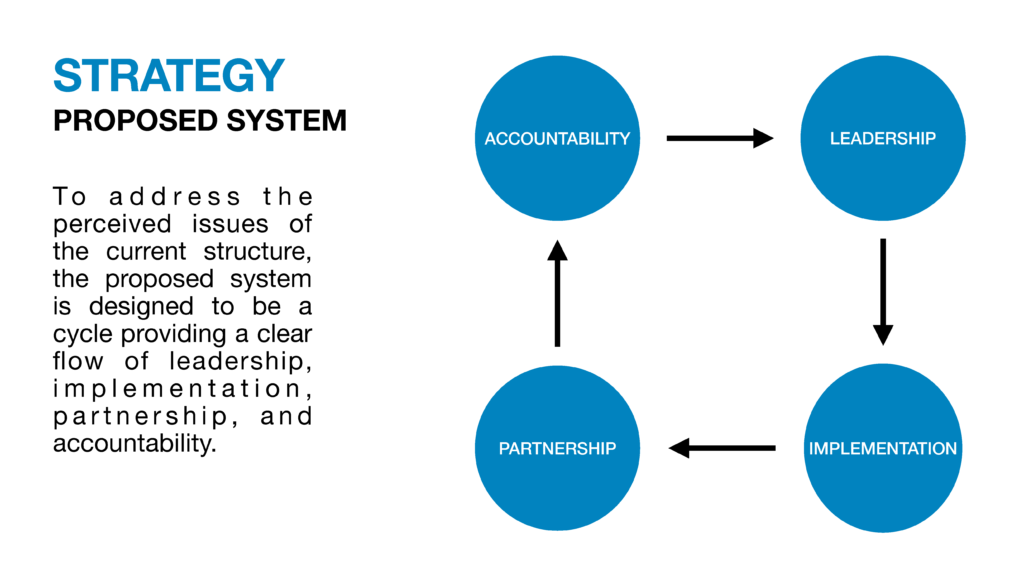
To address the perceived issues and values, the RTF proposed a new structure to the Executive Council in October 2020. The new structure is designed to provide a flow of leadership, implementation, partnership, and accountability. These four circles become a cycle through which the organization functions effectively.
The first circle in the proposed system is Leadership.
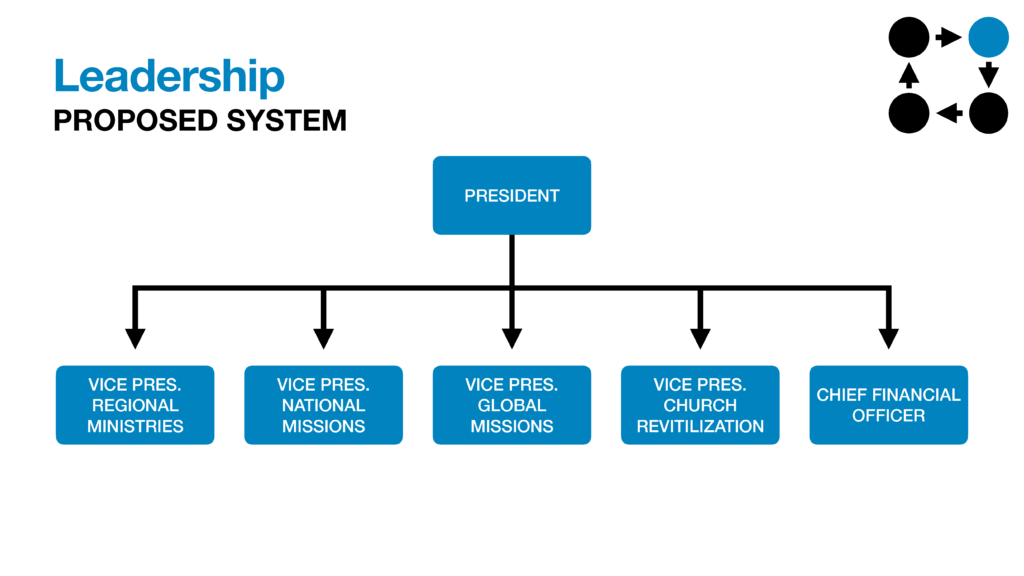
The restructure of the current leadership model is designed to accomplish the goals of empowered leadership, missional accountability, and a clear and flexible structure. The title of Executive Director is changed to President, to clarify the leadership and authority of the office. The President would be the organization’s visionary leader empowered as the chief decision-making authority for all day-to-day operations.
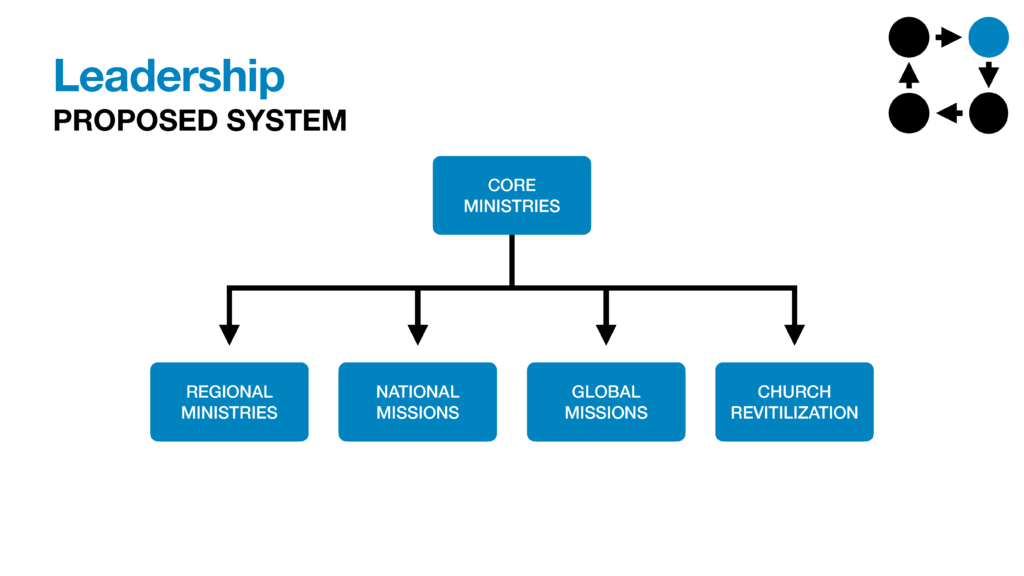
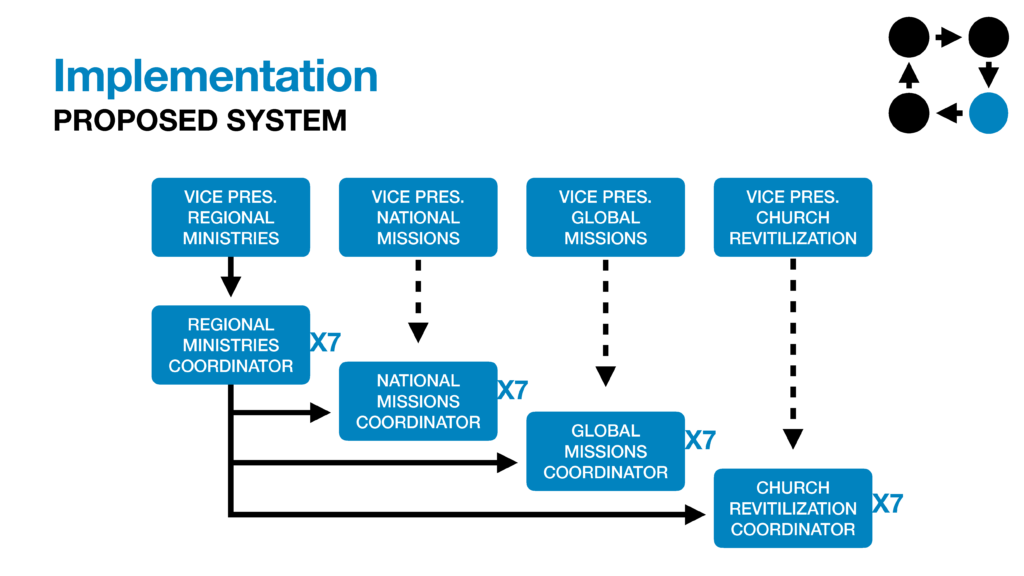
The operations would then be implemented through vice presidents of departments that align around the organization’s mission. In response to the needs of struggling congregations, Congregational Ministries is refocused, given a more specific role, and given a new name of Church Revitalization. To reflect the nature of our movement’s reach around the world, International Missions will also be retitled Global Missions.
The Institutional Ministries (e.g., GBIF, OaklandCity University, Stinson Press) that exist to aid, assist, and support the core ministries of the organization will have the same relationship in the new structure. Women’s Ministries will become an Institutional Ministry rather than be classified as a Support Ministry.
The second circle is Implementation.
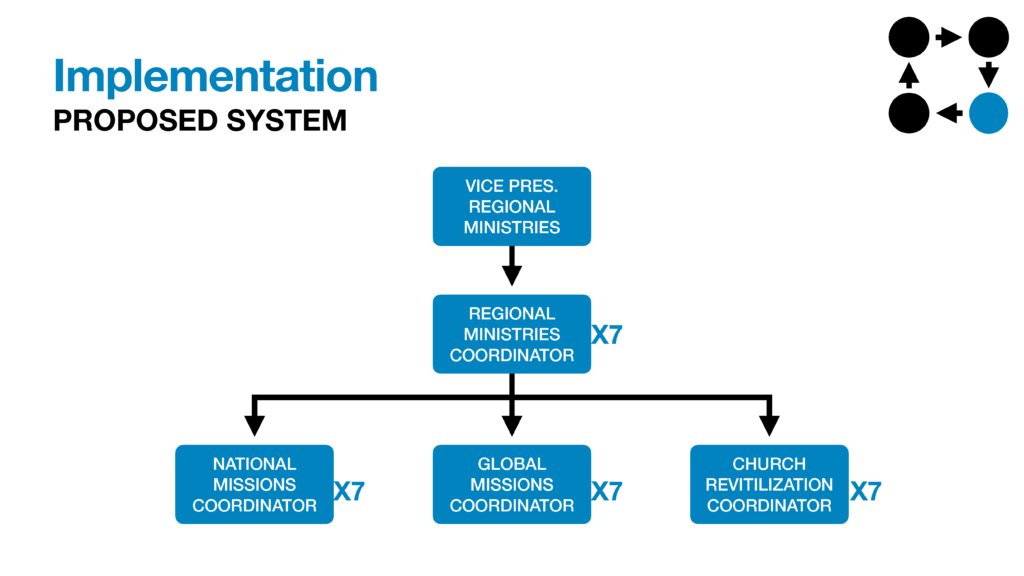
To accomplish the goals of empowered leadership and cultural adaptability, a new level of support staff is proposed in a regional ministry model (regions will be explained below under Partnership). The proposed additions will allow for ministry to be implemented at a grassroots level rather than solely out of a national office. The multiple support staff in each region would be specialists and champions of the organization’s missional areas. These specialists would be supervised by a coordinator in each region who implements the organization’s strategic plan developed by and in coordination with the departmental vice presidents. All of the regional coordinators would be report directly to a newly created position of Vice President for Regional Ministries.
The third circle is Partnership.
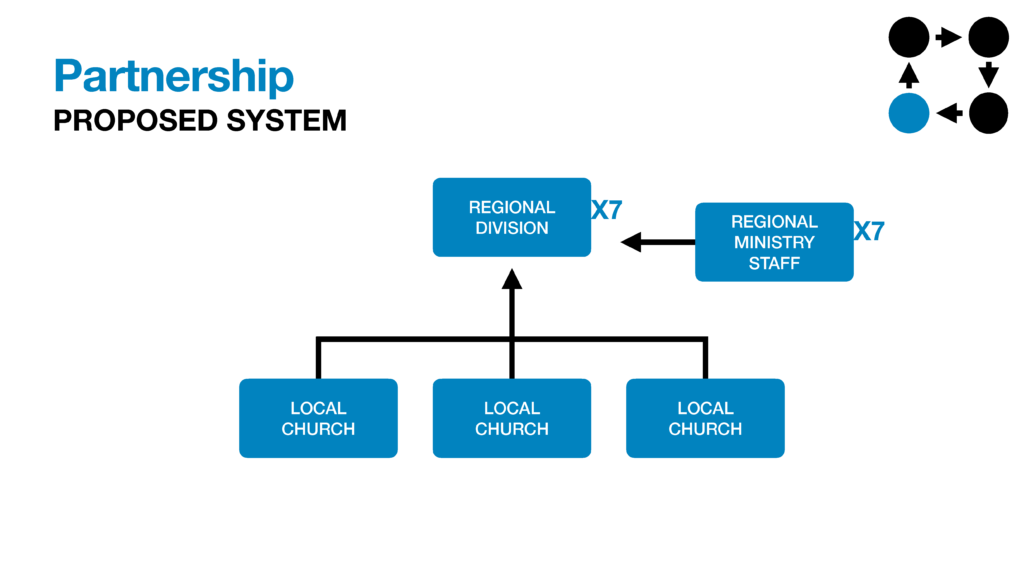
The regional ministries divide the movement into regions to accomplish cultural adaptability and provide a clear and flexible structure. The RTF has suggested that we begin with seven (7) total regions—five (5) in the United States and two (2) international.
The various regions will allow for better communication for a global movement through not only regional support services but also regional Summit meetings. Churches would be placed into these regions based upon geography for services and support. RTF has intentionally not touched the workings of the local associations. The regions will exist without reference to associations. For example, some associations are less regional and could potentially have churches in multiple regions. The exact divisions of the regions would be left to the President and a Board of Overseersto determine to provide the most effective services to each region.
The fourth and final circle of the new structure is Accountability.
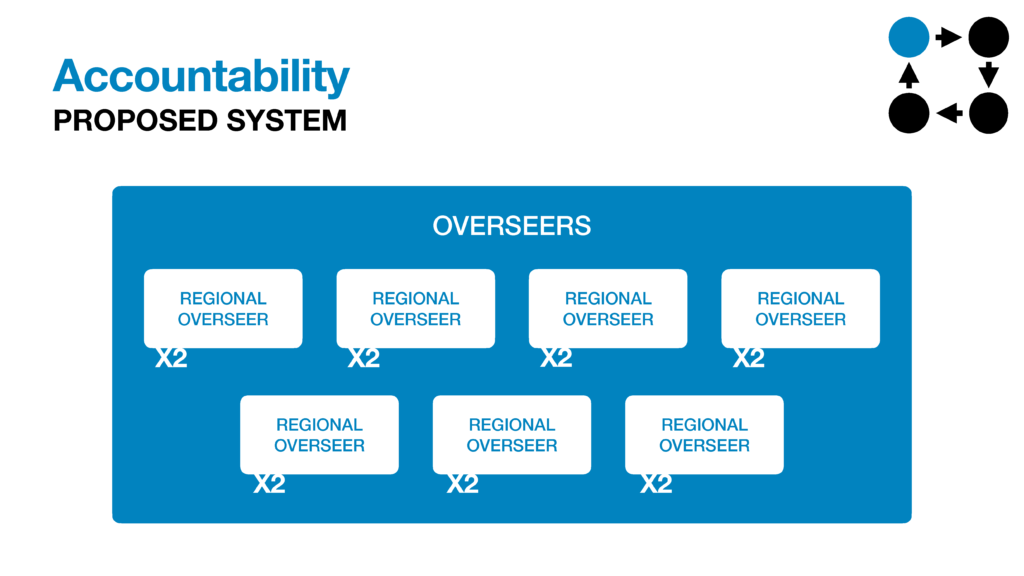
The restructure of the current governing model can accomplish the goals of empowered leadership, missional accountability, and a clear and flexible structure. The proposal includes a fourteen (14) person Board of Overseers who keep the President accountable, approve the operating budget, and evaluate and approve the annual strategic plan. Each region would elect two (2) overseers for four (4)year terms offset every two (2) years. Overseers would be selected by partner churches at newly established regional Summit meetings.
The Actions of the Executive Council and the Council of Associations
When the RTF made its report to the Executive Council in October, the Executive Council took action to begin moving toward the new proposed structure. The following actions were taken by unanimous vote:
- Per the Council of Associations Bylaws, Article6, the Executive Council directed the Personnel Committee to temporarily consolidate the Congregational Ministries department into the office of the Executive Director. This action allows the Executive Director to begin transitioning resources from the Congregational Ministries department into the more specific Church Revitalization department and absorb some of the other duties into the office of the Executive Director.
- Per the C/A Bylaws, Article 6, the Executive Council recommended that the Council of Associations establish a Regional Ministries department and a Church Revitalization department to be approved at the next meeting of the General Association in July 2021.
- The Executive Council instructed the RTF to bring recommended changes to the constitutions and bylaws of the Council of Associations and the General Association to the May meeting of the Council of Associations to fulfill the proposed model. At the November meeting of the Council of Associations, the RTF also made a presentation of its findings. The Council of Associations took the following actions by unanimous vote:
- The Council of Associations established a Regional Ministries department and a Church Revitalization department to be approved at the July 2021 meeting of the General Association.
- The Council of Associations endorsed the executive Council’s instructions to the RTF to bring recommended changes to the constitutions and bylaws of the Council of Associations and the General Association to the May meeting of the Council of Associations to fulfill the proposed model.
Next Steps
The RTF has begun work to complete the task of revising the constitutions and bylaws of the two bodies and will be prepared to make the recommendations for those changes to the Council of Associations in May. The RTF also plans to present the documents to the Executive Council at its March meeting and to present the documents to the larger General Baptist family for input before the Council of Associations’ meeting in May.
The following items are planned for the agenda of the General Association meeting in July 2021 for approval:
- Permanent creation of the Regional Ministries department and the Church Revitalization department.
- Approval of changes to the constitution and bylaws of the Council of Associations.
- The first vote on approval of the changes to the Constitution and Bylaws of the General Association (those changes would not become final until a second vote at the 2022 General Association meeting).
As opportunities arise for you to provide input on the reorganization, you are encouraged to participate. Please be in prayer for General Baptists as we move through these transitions!
For more information and to keep up to date with these transitions visit www.GeneralBaptist.com/Restructure